Introduction
In the demanding world of marine engineering, few tasks require as much precision and logistical expertise as replacing critical exhaust system components onboard a vessel at anchorage. Veins Marine Engineering Solution (VMES) recently demonstrated exactly that capability with the successful supply and installation of a custom-fabricated EGCS Expansion Joint Bellows onboard MV SOTIRIA (IMO: 1040356) at Chattogram Outer Anchorage, Bangladesh.
From material procurement and custom fabrication to workboat logistics and precision onboard installation — the entire project was executed safely, efficiently, and to the complete satisfaction of the vessel’s Chief Engineer.
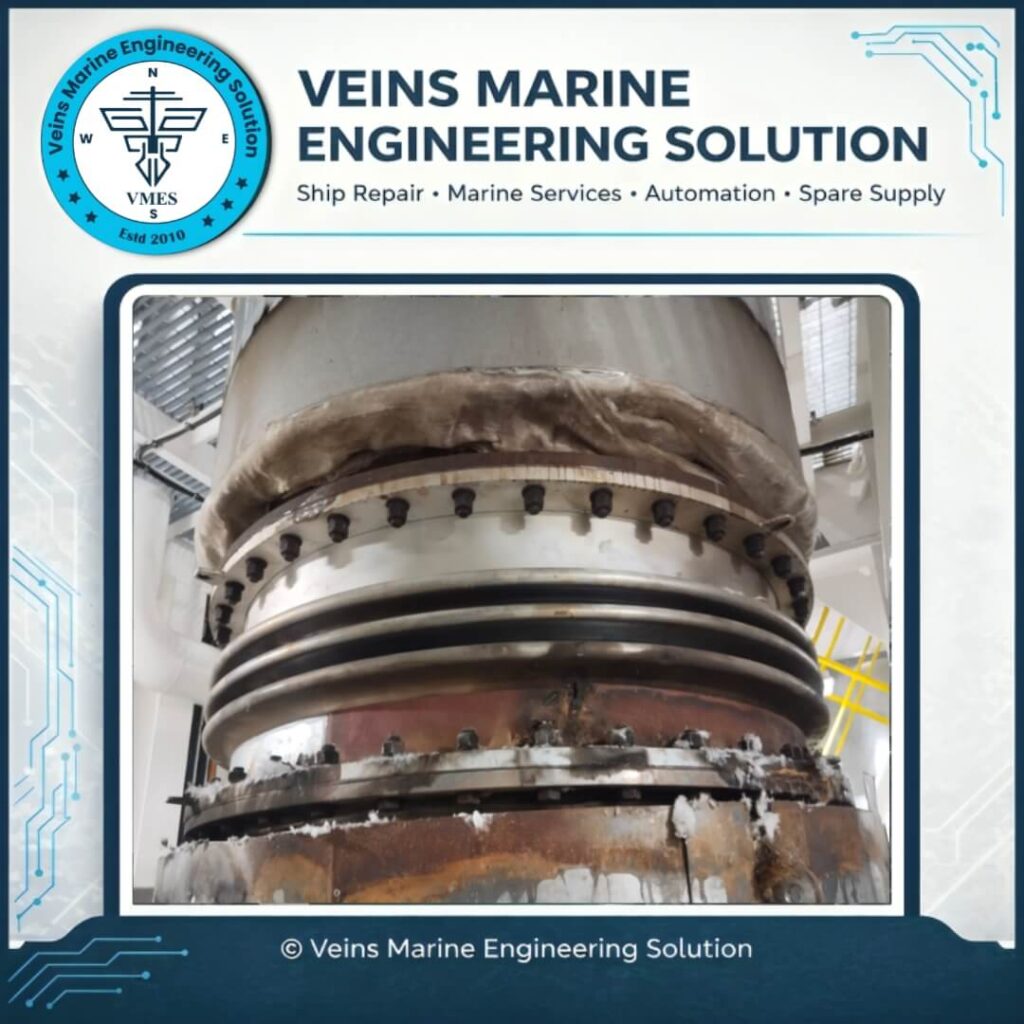
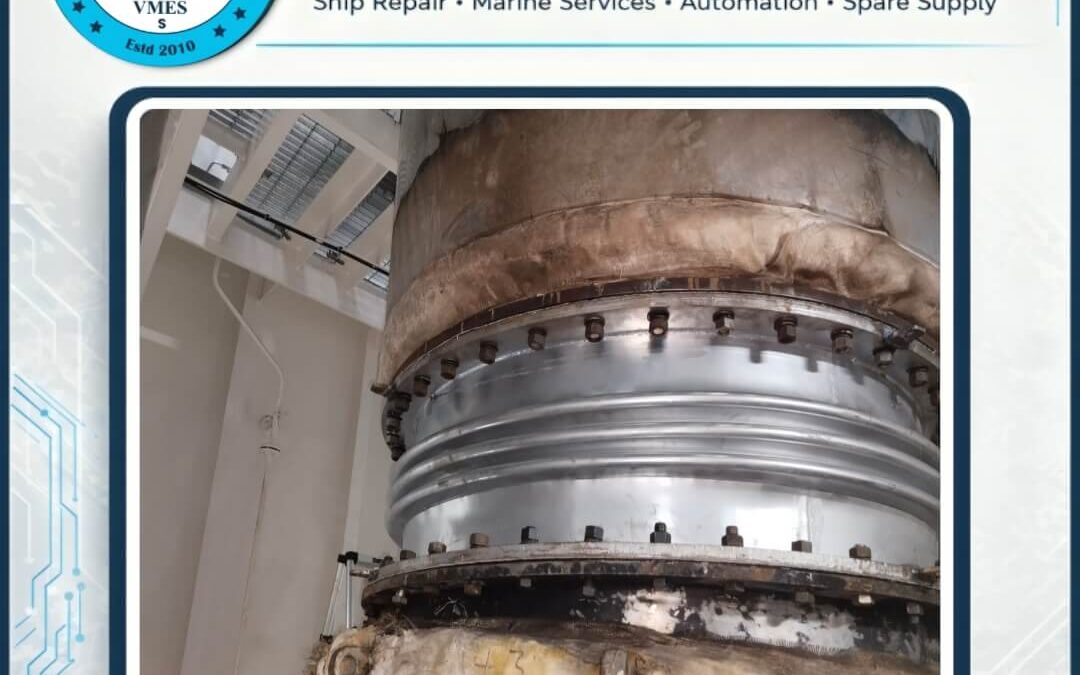
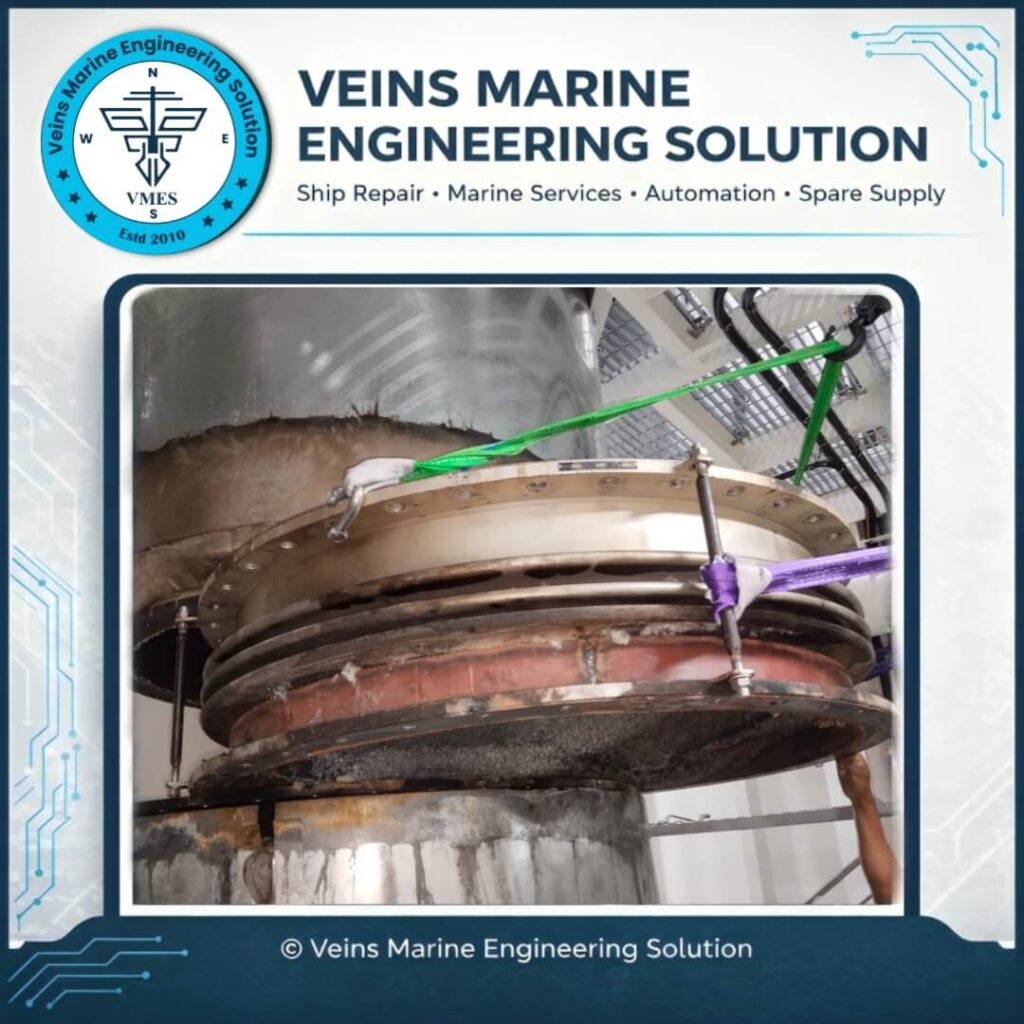
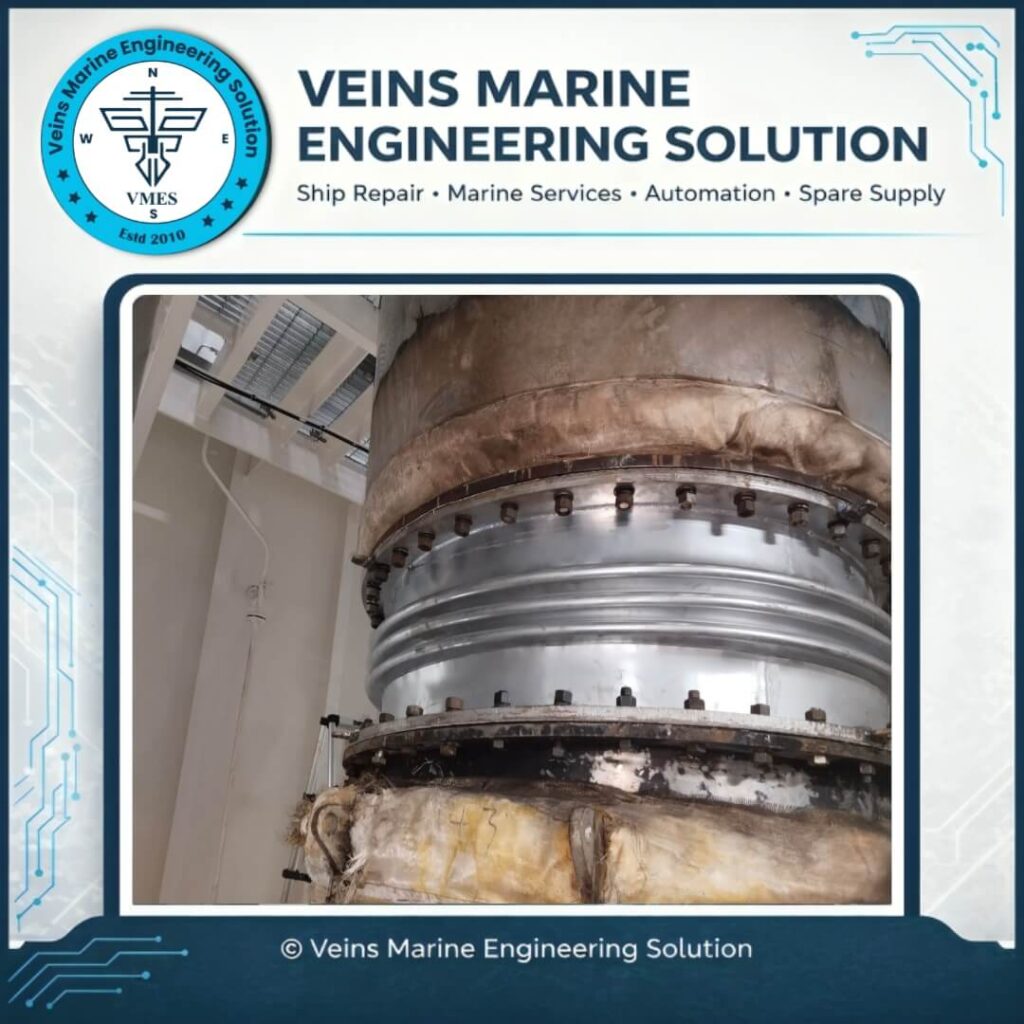
Existing EGCS bellows in deteriorated condition onboard MV SOTIRIA — prior to EGCS bellows replacement by VMES, Chattogram Outer Anchorage
What Is an EGCS Expansion Joint Bellows — And Why Does It Matter?
An Exhaust Gas Cleaning System (EGCS), commonly known as a scrubber, is installed on vessels to reduce sulphur oxide (SOx) emissions from the main engine exhaust — a requirement under IMO MARPOL Annex VI regulations. The expansion joint bellows is a critical flexible connector within the exhaust gas line of the scrubber system.
Its function is to:
- Absorb thermal expansion and contraction of the exhaust piping
- Isolate vibration between the engine and the exhaust stack
- Maintain a gas-tight seal under high-temperature and high-pressure exhaust gas conditions
- Compensate for minor misalignment between connected pipework sections
When the bellows deteriorates — due to corrosion, fatigue, or thermal damage — it compromises the integrity of the entire exhaust gas line, creating a risk of exhaust leakage, emission non-compliance, and potential safety hazards onboard. Timely replacement is not optional; it is a regulatory and operational necessity.
Project Details at a Glance
| Parameter | Details |
|---|---|
| Vessel Name | MV SOTIRIA |
| IMO Number | 1040356 |
| Location | Chattogram Outer Anchorage, Bangladesh |
| Job Reference | VMES/QUO/REF-0167/2026 |
| System | EGCS – Exhaust Gas Cleaning System (Scrubber) |
| Component Replaced | Expansion Joint Bellows Assembly |
| New Bellows Material | UNS S32205 – Duplex Stainless Steel 2205 |
| Material Standard | ASTM A240/A276 · EN 1.4462 |
| Scope | Supply · Removal of old unit · Installation · Lagging reinstatement |
| Completion Status | ✅ Successfully Completed – Signed off by Chief Engineer |
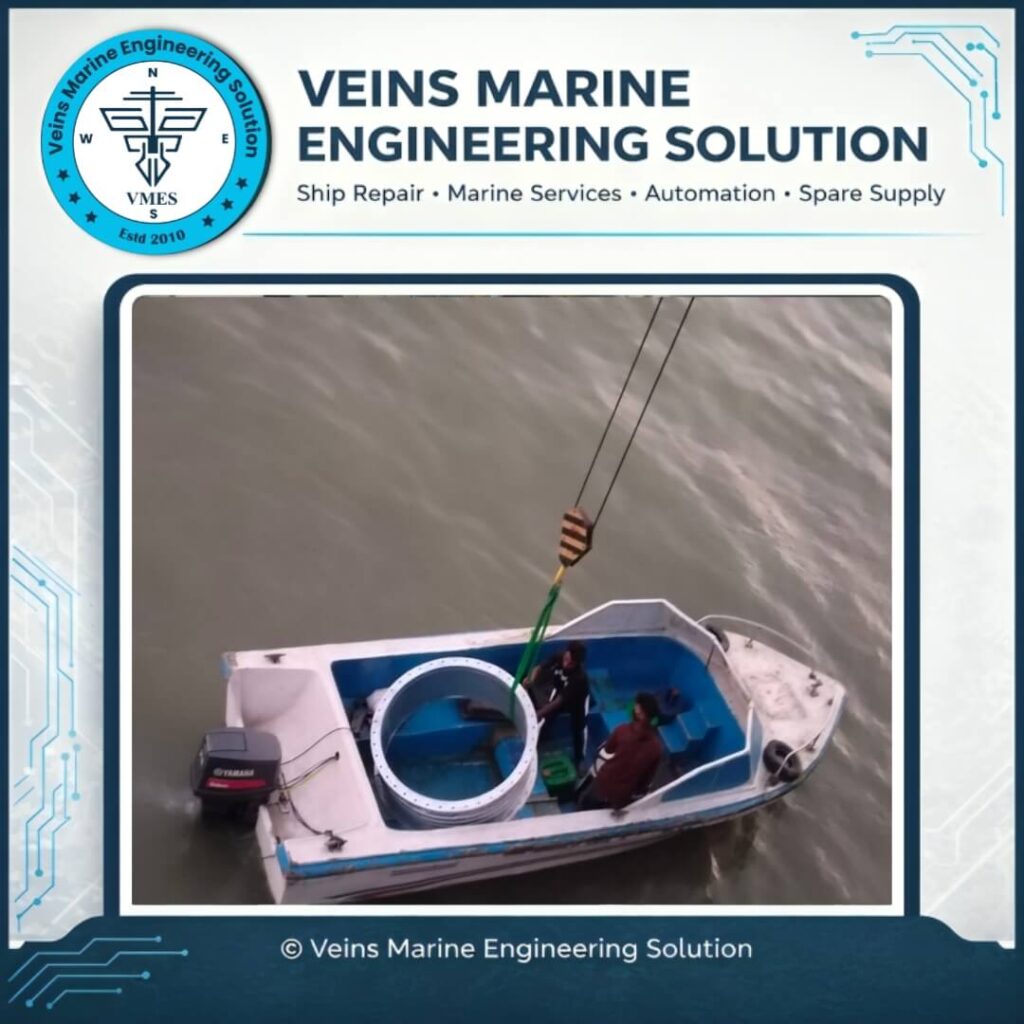
Custom-fabricated EGCS bellows unit being transported by workboat to MV SOTIRIA at Chattogram Outer Anchorage — EGCS bellows replacement by VMES
Material Selection — Why Duplex Stainless Steel 2205?
The replacement bellows was custom-fabricated in UNS S32205 Duplex Stainless Steel (2205) — a premium material grade specifically engineered for demanding marine exhaust applications. The selection was driven by the following technical considerations:
- Corrosion Resistance: Superior resistance to sulphuric acid and chloride-containing scrubber wash water, which is highly corrosive to standard stainless steels
- High-Temperature Performance: Maintains structural integrity under the elevated temperatures of exhaust gas flow
- Fatigue Resistance: High tensile strength and fatigue resistance under repeated thermal cycling and mechanical vibration
- Regulatory Compliance: Material supplied with full Manufacturer’s Material Certificate (MMC) in accordance with ASTM A240/A276 and EN 1.4462 standards
Detailed Scope of Work
The project was executed in a structured sequence to ensure safe handling, correct installation, and full compliance with marine engineering standards:
- Pre-Work Planning: Onboard site survey, rigging plan preparation, risk assessment, and coordination with the vessel’s Chief Engineer and deck crew
- Bellows Transportation: Custom-fabricated bellows transported from shore to vessel by dedicated workboat at Chattogram Outer Anchorage
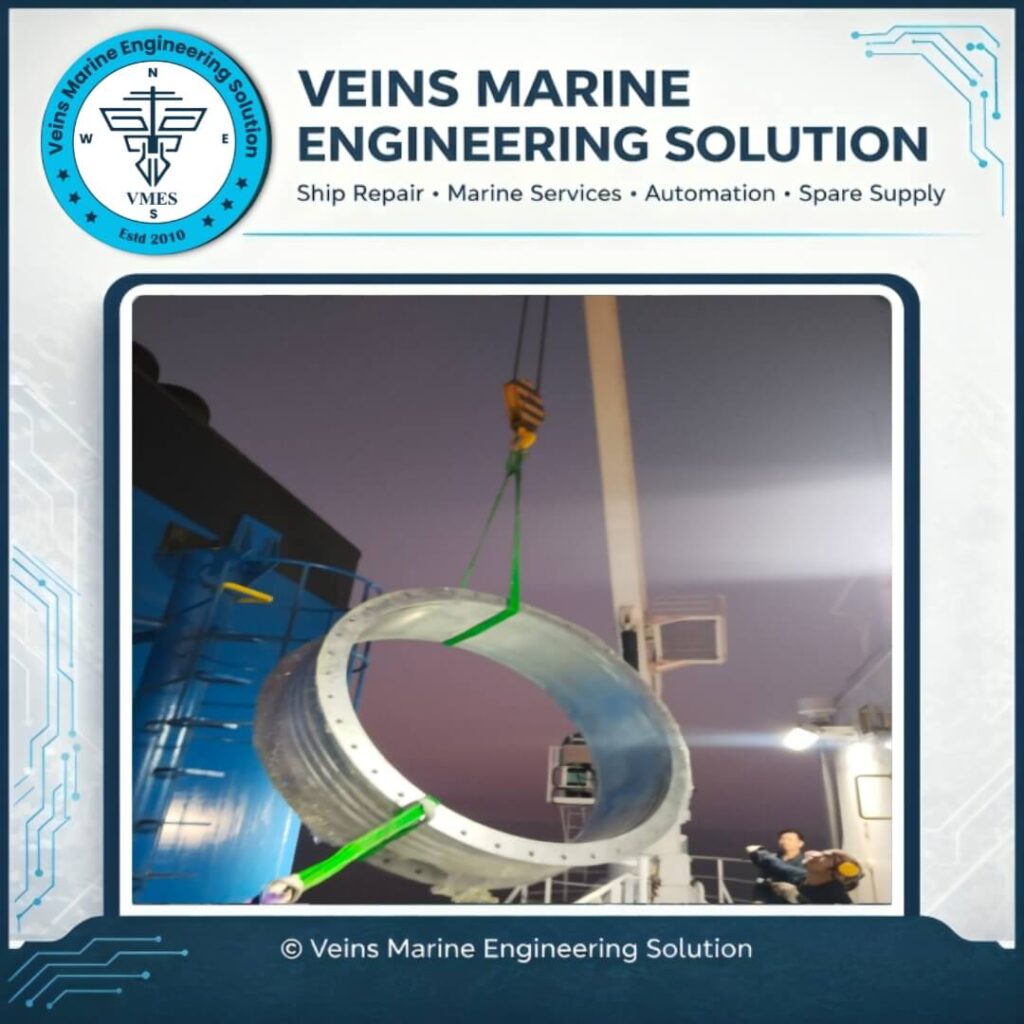
- Crane-Assisted Transfer: Heavy bellows unit lifted from workboat to vessel’s deck using ship’s crane — safely executed under live anchorage conditions
- Lower Bellows Securing: Existing lower bellows temporarily secured to prevent stress transfer and movement during the removal of the upper unit
- Removal of Old Bellows: Existing lagging and outer protective cover removed; old deteriorated bellows unbolted and lifted clear using chain blocks and slings
- Flange Preparation: Mating flange faces cleaned, inspected, and prepared; surface condition verified before installation
- Gasket Fitting: New high-temperature gaskets fitted and correctly seated on both flange faces
- Precision Installation: New bellows unit hoisted into position; precise concentric alignment achieved between upper and lower flanges before final lowering
- Controlled Bolting: All flange bolts fitted and tightened in a standard cross-torque sequence to ensure even gasket compression and prevent flange distortion
- Final Inspection & Sign-Off: Post-installation inspection completed; all documentation reviewed and signed by the vessel’s Chief Engineer confirming satisfactory completion

Removal of old EGCS bellows using chain block and rigging slings — EGCS bellows replacement onboard MV SOTIRIA by VMES
New EGCS bellows hoisted into installation position by crane — EGCS bellows replacement onboard MV SOTIRIA, Chattogram Outer Anchorage
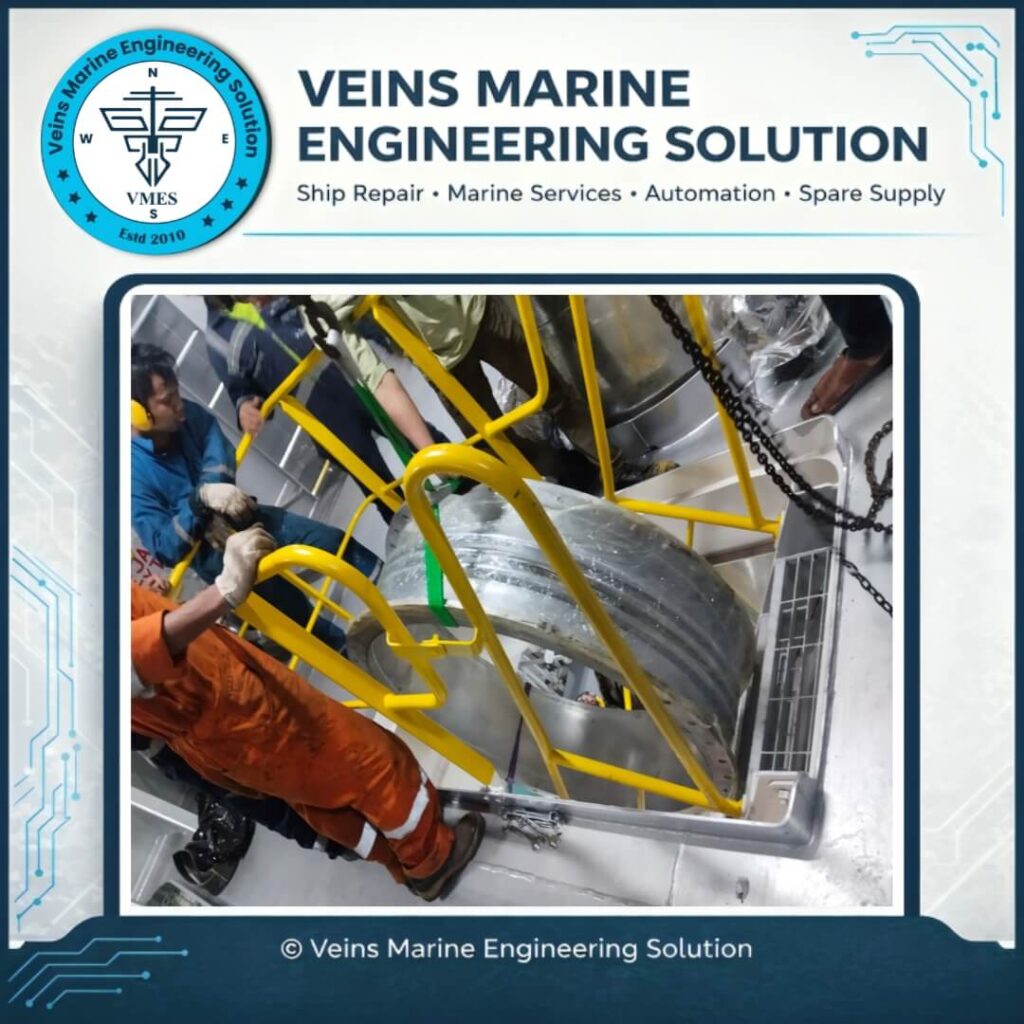
New EGCS bellows carefully manoeuvred through restricted deck access — EGCS bellows replacement onboard MV SOTIRIA by VMES
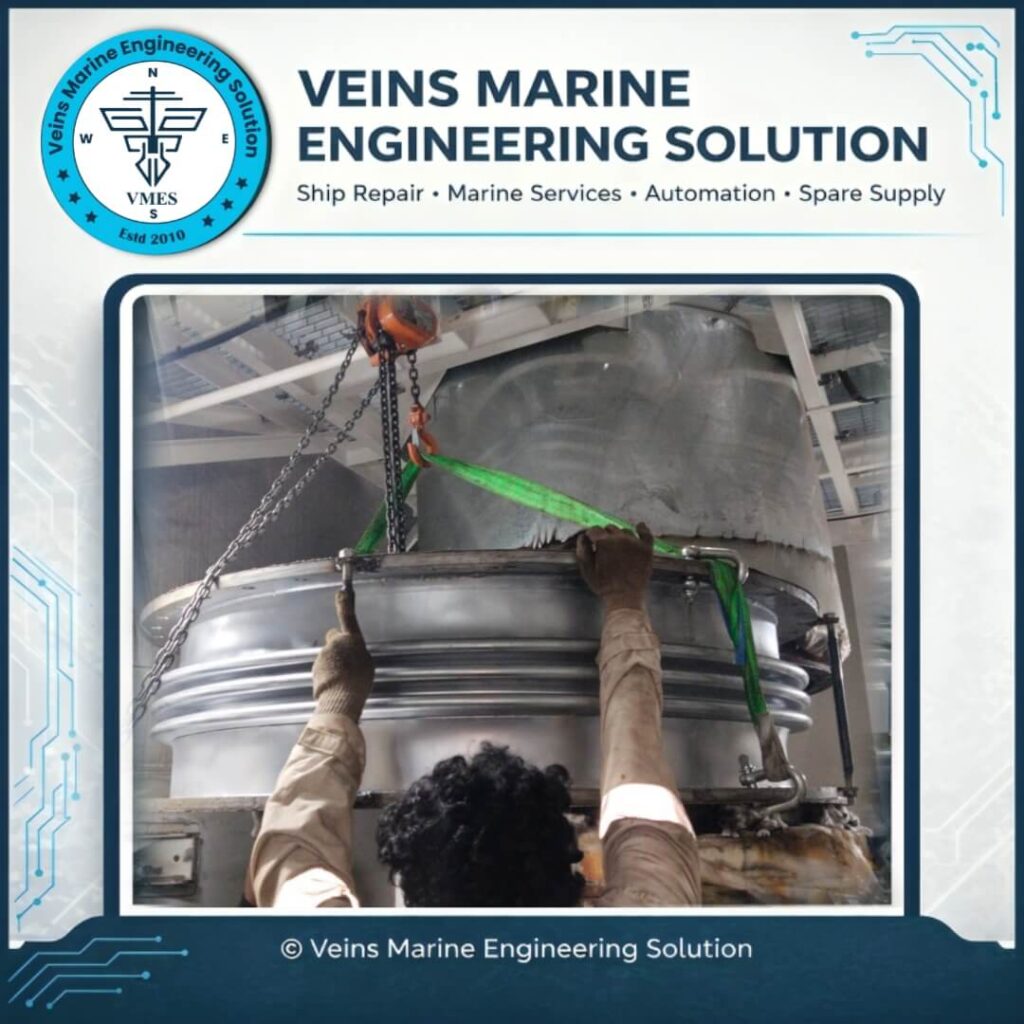
VMES technical team guiding new EGCS bellows into precision flange alignment — MV SOTIRIA, Chattogram Outer Anchorage
Key Challenges & Engineering Solutions
1. Live Anchorage Logistics With MV SOTIRIA positioned at Chattogram Outer Anchorage, all personnel, tools, and the heavy custom bellows unit were mobilized entirely by workboat — a logistically complex operation that required careful pre-planning and coordination with the vessel’s crew.
2. Heavy Component Handling at Sea The large-diameter, heavy bellows assembly required crane-assisted transfer from the workboat to the vessel’s deck in open anchorage conditions, where minor vessel movement adds a significant safety variable. The operation was executed safely through meticulous rigging preparation and real-time crew coordination.
3. Restricted Working Space Between Decks The EGCS bellows is installed within a confined space between decks with very limited working clearance. Temporary onboard handling and guiding arrangements were specifically devised to manoeuvre the new bellows through the deck access opening without damage to the unit or surrounding structure.
4. Stress-Free Alignment Under Anchorage Movement Achieving a precision stress-free installation during minor vessel movement required constant communication between the rigging team above and the installation crew below. A controlled multi-point lowering technique using both chain blocks and slings was employed to achieve the required concentric flange alignment before final bolting.
Project Outcome
The EGCS Expansion Joint Bellows replacement onboard MV SOTIRIA was completed successfully, safely, and on schedule. The project stands as a clear demonstration of VMES’s technical capability to deliver complex anchorage repair solutions under challenging conditions — combining precision engineering, certified materials, structured execution methodology, and strict safety compliance.
All works were completed to the complete satisfaction of the vessel’s management and senior officers. The work completion report and material certificates were formally signed and accepted by the Chief Engineer onboard, confirming the quality of both materials supplied and workmanship delivered.
EGCS bellows replacement successfully completed onboard MV SOTIRIA — new Duplex SS 2205 bellows fully installed and accepted by Chief Engineer | VMES, Chattogram Outer Anchorage
Frequently Asked Questions
What is an EGCS bellows and when does it need replacement? An EGCS expansion joint bellows is a flexible connector in the exhaust gas scrubber line. It requires replacement when it shows signs of corrosion, cracking, thermal fatigue, or leakage — typically identified during routine inspection or when exhaust system performance degrades.
Can this work be done at anchorage without drydocking? Yes. VMES specialises in anchorage and afloat repair services. EGCS bellows replacement can be performed at anchorage with proper planning, rigging, and coordination — avoiding costly and time-consuming drydock scheduling.
What material is used for EGCS bellows replacement? VMES supplies custom-fabricated bellows in UNS S32205 Duplex Stainless Steel (2205), certified to ASTM A240/A276 and EN 1.4462 standards — the industry-recommended material for EGCS exhaust line applications due to its corrosion and fatigue resistance.
About Veins Marine Engineering Solution (VMES)
Veins Marine Engineering Solution (VMES) is a leading marine engineering company based in Chattogram, Bangladesh, established in 2010. We provide a comprehensive range of marine engineering services including ship repair, EGCS system maintenance, automation, and spare parts supply to vessels calling at or anchored at Bangladesh ports.
Our Service Locations: Chittagong · Mongla · Payra · Matarbari
📧 technical@vmesbd.com 📧 supply@vmesbd.com 📧 repair@vmesbd.com🌐 www.vmesbd.com